May 29, 2026
President Eric Murray's weekly Friday letter
Global Awareness
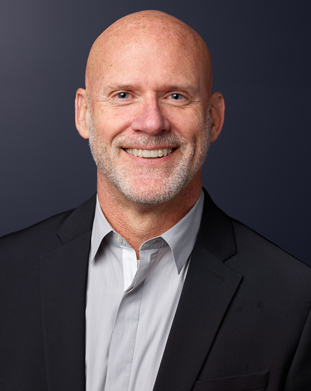
We have a guest author today. I’ve asked Founding Faculty member Dianne Fruit to talk about one of Cascadia’s original values, Global Awareness. Before we get to those comments, I would like to invite you to two events on Monday.
Please join me, UW Bothell Chancellor Kristin Esterberg, and Bothell City Councilmember Carston Curd as we raise the campus flag to celebrate June’s Pride Month. This second annual UW Bothell / Cascadia Pride Flag Raising event will take place on Monday, June 1, from 11:00 to 11:30 AM at the north end of campus at the flagpoles. We’ll offer some opening remarks before we raise the flag. We welcome everyone from our campus communities to gather in recognition of this important symbol of pride, visibility, and belonging. The flag will be flown throughout the month of June and in coordination with our Juneteenth observance. A small selection of Pride-themed goodies will be available. This event is organized by members of the queer faculty and staff community and open to all regardless of race, gender, or other identity.
And then Monday night, starting at 6:30 PM, please join me and the Northshore Rotary as we raise money for student scholarships by playing Bingo at Copperworks Distillery in Kenmore. This is a kid-friendly event and helps us support full-ride scholarships for Cascadia students.
Now on to our main attraction…and thanks to Dianne!
As President Murray mentioned in his April 10 Friday Letter, Global Awareness is one of Cascadia’s nine founding values. It’s one that’s always been vital to our mission, but it’s even more so now. And I would argue that “awareness” is a good primary step, but it should not be an end goal. How we respond to that awareness is the real question. The underlying values within the scope of global awareness give us a pathway for action. These are the values of collaboration and connection, respect and multiple perspectives. A global education helps us to communicate with clarity and wisdom. We approach others with a humility and reciprocity that is cultivated when we realize that our way is not the only way to communicate, order the world, remember the past or envision the future. When we accept the challenge to decenter ourselves and embrace what may be new or uncomfortable, the rewards to our communities are vibrancy, texture, imagination and vitality. Do these fit in a rubric? I don’t know, but I do know I’ve seen them in my students’ eyes, in their exclamations of “I never thought of it that way” or their bewildered “how come we never knew about this before now?” To embrace the values of a global education means learning from others’ experiences, their unique geographies, languages, cultures and stories. Those gifted with a global education are indisputably more equipped in heart and mind to face the challenges of the times and places we find ourselves in. They can apply their experience and skills in any setting, profession or life path, whether it’s across the globe or around the corner. They’re more adaptive employees, engaged citizens and compassionate neighbors.
We have a long history of supporting global education with numerous Global Studies designated courses, and, of course, all disciplines intersect in some way with the global and the local. Many of our instructors over the years have done incredible work to make these connections come alive in tangible, practical ways for their students. Our campus has offered study abroad programs, held live video sessions with classes across the globe, participated in Collaborative Online International Learning (COIL) programs and benefitted from the perspectives of and friendships with our international students on campus.
The Global Education Committee (GEC) has been active since Cascadia opened its doors. Thanks to the work of many faculty and staff members over the years, our campus community has benefitted from visiting scholars from countries such as Albania, Argentina, Costa Rica, Cuba and Mexico; workshops on globalizing the curriculum; campuswide, annual themes; student and faculty panels; brown bag discussions; film screenings and speakers who’ve packed Möbius Hall; story discussion groups; library exhibits; and much, much more. All this happened, not with dedicated financial support from the institution, but because Cascadians insisted on the power and importance of global education and cultural competency, and devoted time and energy to making these experiences available for everyone.
In order to provide a world class education for our students, we must bolster the courses and activities that support it. When we as a college or society reduce access to language proficiency and cultural competency, we put learners at a serious disadvantage. Experiencing difference and new cultures is applauded in many nations. Yet, for many of our students, the time and money required to study abroad or take more Global Studies designated classes is prohibitive. This has been one of the reasons the GEC has believed so strongly in bringing the global home to our campus with free events, global curriculum design support for our faculty and highlighting the global within the local.
Many now believe technology makes efforts to learn languages or delve into other cultures meaningless. AI can seemingly do it all. As I share with my students, language acquisition is much more than vocabulary lists and verb conjugations. It’s knowing the people, their art and history, their food, body language and values. Cultural competency is inherent in language proficiency, and they aren’t just in your mind. They’re in your heart and become part of who you are. No amount of technology can do that for us because it’s a uniquely human venture.
I hope we recommit to prioritizing our global education values. We need them more than ever, and we need global education just as we need all of Cascadia’s values. They work best together; not one can do the work of any other, and if one is missing, all are diminished. If we’re not actively learning, teaching and embracing all these values, what are we doing here?
Shoutouts
From Dianne:
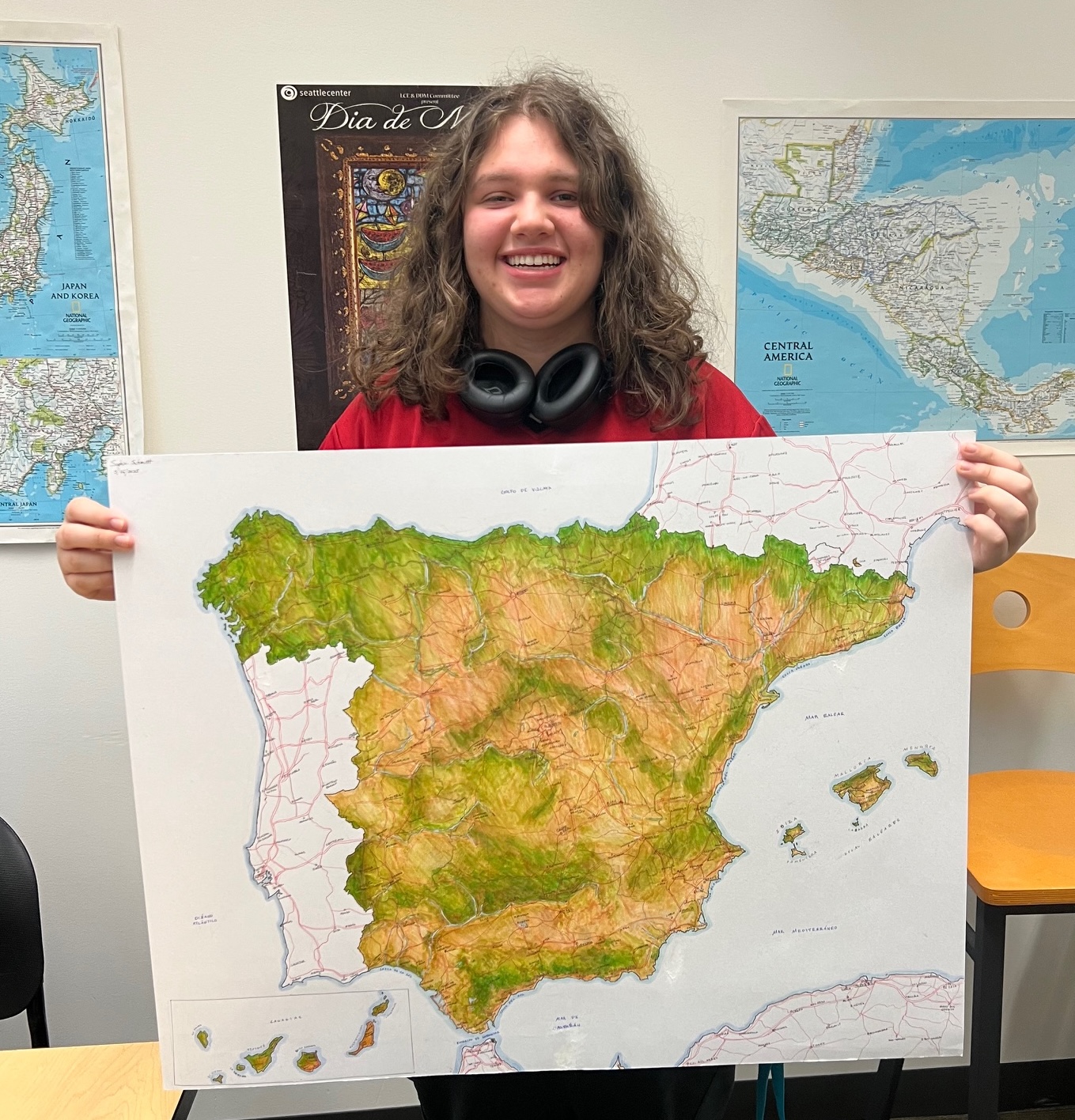
I’d like to send a big shoutout to Cascadia student and Spanish tutor Sophia Schmitt. On her own initiative, she drew, labeled and colored a large map of Spain freehand and donated it to the Language Learning Center. This labor of love took Sophia 40-50 hours to complete.
Kudos to Chantal Carrancho for purchasing a beautiful frame with Guided Pathways funds and to Shannon Bath, Melissa Stoner, Susan Thomas and the Foundation for facilitating and ensuring a stipend for Sophia.
We’re grateful to enjoy this professional, beautiful piece on our campus! Come check it out in our Language Learning Center in the Global Learning and the Arts Building.